
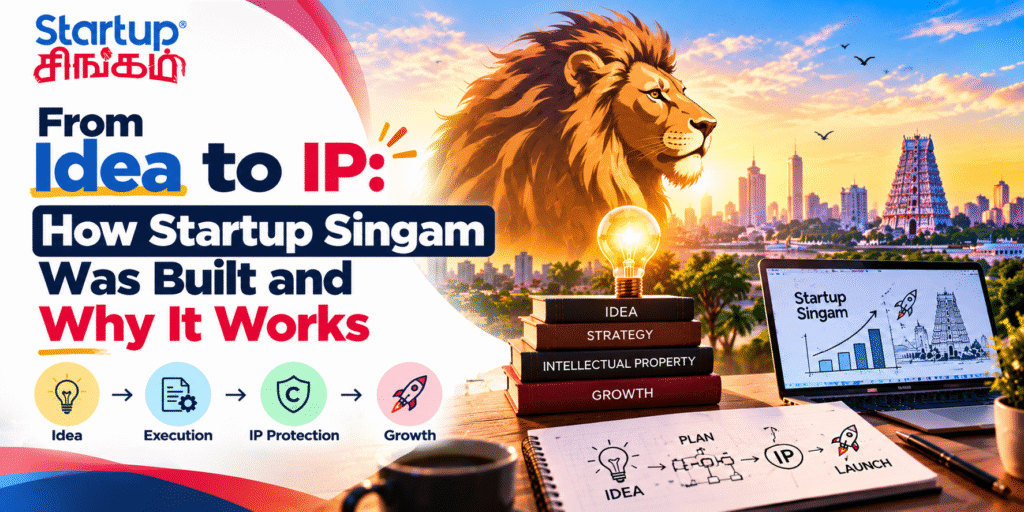
Startup Singam began as a plan for a one-time founders’ event in Chennai. It became an original television IP owned by a startup, Baanhem Ventures, and South India’s first mainstream startup reality show. Two seasons are complete so far, featuring 114 startups across 40 episodes, with roughly ₹140 crore in Season 2 investment commitments alone.
For years, startup money in India has clustered around Bengaluru, Mumbai and Delhi. A food brand in Tirunelveli or a robotics team in Coimbatore could build a real business and still never meet an investor. Startup Singam set out to fix that gap, in Tamil, on prime-time television.
This is the story of how the idea was built, who backed it when nobody else would, and what other founders can learn from the way it grew.
The spark: an event, not a TV show
The idea came from Hemachandran L, a Chennai media entrepreneur who runs Brand Avatar, a branding, events and media production company. He grew up in Arakkonam, studied at Crescent Engineering College and invests as an angel with The Chennai Angels.
Startup Singam was never planned as television. According to Oneindia, Hemachandran was inspired by large innovation gatherings like GITEX in Dubai, where people from very different backgrounds meet around new ideas.
He wanted the same energy for Tamil Nadu, with three conditions:
- Regional first. Built for Tamil Nadu’s own ecosystem, not a copy of a Bengaluru event.
- Local language. Run in Tamil, so founders could pitch the way they actually talk.
- Small towns included. Open to entrepreneurs from tier-2 and tier-3 towns and villages, not only metro founders
From a one-time event to a company
The turning point came from cofounder Balachandar R of Blue Koi Ventures. His argument was simple: an event creates a moment, but a company can create value that lasts. That reframing turned a single gathering into a business.
The two founders set up Baanhem Ventures Private Limited to build and own the platform. Its mission line, still used today, is to simplify fundraising and amplify success stories.
The early road was slow. Balachandar has written that it took the team about two years and countless investor meetings to raise their first ₹3 crore. Most people they pitched said no.
How the Startup Singam IP was created
Startup Singam is an original IP: the show, its name, its format and its sub-brands were conceived and built by Baanhem Ventures, which Hemachandran and Balachandar founded in 2023 (Venture Intelligence). The show is produced by Baanhem with Blue Koi, Brand Avatar and Mudhal Partners, and airs on Star Vijay and JioHotstar (Wikipedia).
That structure matters. Because a startup created the IP, investors back the company that owns it, not a single season of television. Baanhem has raised two funding rounds around the IP, first from Kumar Vembu and then from founders such as Girish Mathrubootham and Gopal Srinivasan.
The IP was built from a few deliberate pieces:
- A name with meaning. Singam (lion) stands for the founder, not the investor, giving the show its Founders First identity.
- A rallying cry. இது கனவுக்கான கர்ஜனை, “This is for dreams to roar”, ties every season and event to one emotion.
- Four pillars. The show’s own site frames each episode around Empowerment, Education, Entrepreneurship and Emotion (startupsingam.com).
- A repeatable format. Three startups per episode, a fixed investor panel, a Chief Mentor and a season finale with awards.
- Sub-brands around the show. Scale Hub, The Founder Room, The Roar Table and the bootcamps carry the IP into the months between seasons.
The first season followed a planned production cycle, which became the template for later seasons:
- February–October 2024: applications open, startups are shortlisted and mentored.
- December 2024: shooting of pitches and founder journeys.
- January 2025: telecast begins on Republic Day.
Finding the first believer: Kumar Vembu
The “yes” that changed everything came from Kumar Vembu, co-founder of Zoho and founder of the family office Mudhal Partners. In his own account on Medium, he says he liked the idea immediately, and Mudhal committed in principle to invest at the very first meeting.
What won him over was purpose, not just profit. He framed the key question as “return on investment or return on impact”, and the founders convinced him they wanted both. Having built software for small businesses across India for nearly two decades, Vembu had seen many profitable owners who had never been taught ideas like gross margin or ROI. A show could teach those ideas to a whole state.
There was one catch. Vembu is famously private and told the founders he would invest but would not appear on camera. Hemachandran and Balachandar kept asking, and before the final shooting schedule they visited him at home to make their case. He agreed, reasoning that his presence could teach both founders and new investors how startup deals really work. He went on to become the show’s Chief Mentor.
Founders First: why the founder is the Singam
The biggest design choice was in the name. On Shark Tank, the sharks are the investors. On Startup Singam, the singam (lion) is the entrepreneur. The team calls this the Founders First Principle.
The founders openly say Shark Tank influenced their thinking, but they built the format differently:
- No manufactured drama. The goal is not on-screen conflict between investors and founders.
- Real, active investors. The panel includes family offices, angel networks and individual HNIs who follow through after the cameras stop.
- No permanent verdict. A founder is not labelled a success or a failure because of one pitch; the business is judged on how well the idea is executed.
- Three kinds of value. Every participant should leave with at least one of funding, mentorship or marketing visibility.
A related idea, which researchers at Christ University describe as the ValueCorn initiative, pushes founders toward sustainable growth rather than chasing inflated valuations.
Season 1: a Republic Day debut
Season 1 premiered on Star Vijay on 26 January 2025, Republic Day, chosen to symbolise entrepreneurial independence. It streamed on Disney+ Hotstar and was hosted by Angelin, known from Vijay TV’s dance show Jodi – Are You Ready?.
The team received over 1,500 applications from Tamil Nadu startups, shortlisted about 50 and featured 39 across 14 episodes, ending on 27 April 2025 (Wikipedia). Sectors ranged from electric vehicles and agri-tech to consumer goods, healthcare and creative industries.
The money was real, and it moved after the show:
- Commitments of over ₹40 crore were made to 35 startups, according to Baanhem’s statement reported by PTI via The Week.
- By November 2025, about ₹20 crore had been disbursed across 17 startups, per Venture Intelligence, including Raptee EV, Kaigal, Savemom, Goat Robotics, Palm Era Foods and YourTribe.
- Backers included Mudhal Partners, Navyug Global Ventures, Metis Family Office, The Chennai Angels, JITO Angels and Native Angel Network.
The exposure mattered as much as the cheques. Palm Era, a palm-based food brand founded by Kannan Hari, reportedly grew monthly revenue from ₹3–4 lakh to about ₹50 lakh after its episode aired. Actor Keerthy Suresh also made headlines by committing ₹60 lakh to young founders on the show.
Vembu later wrote that it became the only show three generations of his family watched together, a sign the format had reached well beyond the startup crowd.
Season 2: from experiment to movement
Season 1 proved the idea; Season 2 scaled it. In September 2025 Baanhem Ventures closed its second funding round and brought in a heavyweight advisory board, including Freshworks founder Girish Mathrubootham, TVS Capital Funds chairman Gopal Srinivasan, CaratLane founder Mithun Sacheti and IppoPay CEO Mohan Karuppiah (The Week / PTI).
The teaser launched at a closed-door founders’ gathering called The Roar Table, and the season premiered on 25 January 2026 on Star Vijay and JioHotstar, again hosted by Angelin.
| Season 1 (2025) | Season 2 (2026) | |
| Applications | 1,500+ (Tamil Nadu) | 4,000+ (all India) |
| Startups featured | 39 | 75 |
| Episodes | 14 | 26 |
| Investment commitments | ₹40 crore+ (Baanhem) to ₹55 crore (Wikipedia) | ~₹140 crore |
The season moved fast. Commitments crossed ₹50 crore within the first eight episodes, helped by a ₹21.4 crore commitment in a single episode, which the show calls the largest in Indian startup reality TV (LatestLY). The biggest single deals included Robonetics Automation (₹11 crore) and Sirimiri (₹10 crore).
By the finale on 19 July 2026, CEO Arun Nair put total commitments at nearly ₹140 crore, with about a quarter already deployed (The Logical Indian). More than 100 HNIs and 25+ investors took part, and around 80% of the HNIs were first-time startup investors. The show was creating new investors, not just new founders.
The stories came from outside the usual startup circle: Sprint6, a smart restroom monitoring system from a diploma holder in Tenkasi, and Vetinstant, an animal vital-monitoring device built by a chartered accountant, an HR professional and a mechanical engineer.
Two seasons done: how the IP runs successfully
As of October 2026, Startup Singam has completed two seasons: 40 episodes and 114 featured startups, from the Republic Day premiere of Season 1 on 26 January 2025 to the Season 2 finale on 19 July 2026. Five habits explain why it keeps working:
- Deals that close after the cameras stop. Season 1 commitments turned into about ₹20 crore actually disbursed to 17 startups, and roughly a quarter of Season 2’s ₹140 crore was deployed by its finale. Follow-through is what keeps founders applying.
- A fast, repeatable deal process. The team works through about 50 investments a year and cut the time from commitment to money in the bank by 30–40% between seasons by getting paperwork ready before due diligence.
- A growing investor network. Family offices, angel networks and over 100 HNIs took part in Season 2, most of them first-time startup investors. Each season adds new investors as well as new founders.
- Credible backers and mentors. Kumar Vembu as Chief Mentor, plus an advisory board of well-known Tamil Nadu founders, gives founders and viewers reason to trust the show.
- Mass reach in the local language. A Sunday slot on Star Vijay, streaming on JioHotstar and Tamil-first pitches put founders in front of families, customers and investors at the same time.
The result is a loop: visible success stories attract more applicants, better startups attract more investors, and more investors make the next season bigger. Applications grew from 1,500+ in Season 1 to 4,000+ in Season 2.
Beyond television: building an ecosystem
Only 75 of 4,000+ applicants could appear on screen, so the team built a pathway for everyone else. Founders who don’t make the show are routed into programmes such as:
- Season Prep and Pitch Bootcamps to sharpen pitches before investors see them
- Scale Hub, which connects promising startups with incubators and accelerators
- The Founder Room and regional ecosystem meet-ups
- Regional Startup Roadshows across Tamil Nadu
Behind the scenes, Startup Singam runs like a high-volume investment desk. CEO Arun Nair has noted that a typical VC firm or angel network closes five or six deals a year, while Startup Singam works through about 50 with a lean team, much of it first-time hires from tier-2 and tier-3 cities.
The team also fixed a classic pain point between seasons. By asking founders to keep compliance and documents ready before due diligence, it cut the time from commitment to money in the bank by roughly 30–40% (Oneindia).
Five lessons from how Startup Singam was built
- Start with a gap you can see. Capital and know-how were stuck in the metros; small-town founders were invisible. The whole product is aimed at that one gap.
- Let a co-founder reframe the idea. Hemachandran had the event; Balachandar saw the company. The bigger business came from that second view.
- Expect the slow “no” phase. Two years and ₹3 crore is a long, hard first raise. One committed believer, Kumar Vembu, made the rest possible.
- Make your values the brand. Calling the founder the singam is not just a name; it shapes how investors behave on screen and how founders are treated off it.
- Own the IP, not just the content. By creating Startup Singam inside its own company, Baanhem can raise money, build sub-brands and run events around the IP all year.
- Build the boring parts too. Bootcamps, Scale Hub and faster paperwork turned a TV show into infrastructure that keeps working between seasons.
What’s next: vertical before horizontal
Despite the momentum, the team is in no rush to copy the format into every state. Its stated approach is “vertical before horizontal”: go deeper in Tamil Nadu first, a state with more than 10,000 DPIIT-registered startups. Telangana, Kerala, Karnataka and Andhra Pradesh are being explored as possible next markets.
For many founders, the biggest win may not be the cheque at all. Appearing on Startup Singam has helped families and neighbours understand what these entrepreneurs are building, making startups a respectable career choice in towns where they once seemed risky. That is the roar the show was built for: இது கனவுக்கான கர்ஜனை, this is for dreams to roar.
